In the intricate world of French patisserie, few confections are as celebrated and as notoriously finicky as the macaron. With their delicate shells, smooth tops, and the iconic ruffled "foot" or "skirt," they represent a perfect marriage of art and science. For seasoned bakers and enthusiastic novices alike, achieving that perfect rise—the hallmark of a well-executed macaron—is the ultimate goal. While many factors contribute to success or failure, one of the most critical, yet often underestimated, steps is the drying or "resting" phase of the shells, particularly in environments with specific humidity levels. Mastering the art of drying shells in 60% humidity can be the pivotal difference between a tray of flawless gems and a disappointing batch of cracked or footless discs.
The macaron's journey begins with a simple list of ingredients: almond flour, powdered sugar, granulated sugar, and egg whites. Yet, the alchemy that transforms these basics into a light, airy delicacy is anything but straightforward. The process is a ballet of precise measurements, specific techniques like macaronage (the folding of the dry ingredients into the meringue), and an intimate understanding of one's environment. The composition of the batter must be just right; overmix it, and it will be too thin and runny, leading to spread-out, flat shells with no structure to form a foot. Undermix it, and the batter will be too thick, resulting in lumpy tops and an incomplete rise. This initial stage sets the foundation, but it is the subsequent drying period that truly locks in the potential for that coveted skirt.
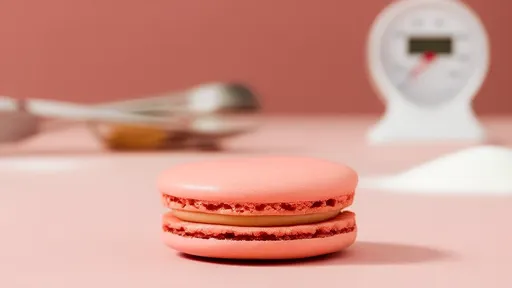
So, what exactly is this "foot," and why is it so important? The foot is the delicate, ruffled edge that forms at the base of the macaron shell during baking. It is not merely a decorative feature; it is a direct indicator of the macaron's structural integrity and textural perfection. Its formation is a direct result of a well-executed drying phase. As the piped shells rest, a thin skin forms on their surface. When these shells are placed in the oven, the heat causes the air and moisture trapped inside the batter to expand and rise. This expanding air pushes upwards, but the hardened skin on top prevents it from escaping through the surface. Instead, the only route for escape is downwards and outwards through the bottom, the path of least resistance. This forceful exit of hot air lifts the shell slightly and pushes the still-wet batter at the base outward, creating the characteristic ruffled skirt. Without this intact skin, the expanding air would simply burst through the top of the shell, causing cracks and leaving no energy to form the foot.
This is where ambient humidity enters the equation as a master variable. Humidity—the amount of water vapor present in the air—profoundly impacts the drying process. In a low-humidity environment, say below 40%, the surface of the macaron shells can dry too rapidly. This can cause the skin to form too thick and too rigid. While a skin will form, its premature hardening can sometimes trap too much moisture underneath, leading to hollow shells, or it can become brittle and crack under the oven's heat anyway. Conversely, in a high-humidity environment, above 70%, the air is so saturated with moisture that the piped batter struggles to release its own water content into the atmosphere. The skin forms very slowly, remains tacky, or may not form a protective layer at all. In these conditions, bakers often find themselves waiting for hours, only to have the shells spread too much or never develop a skin substantial enough to direct the oven's steam downward, resulting in cracked tops or no foot formation.
A humidity level of around 60% presents what many experts consider a "Goldilocks zone" for macaron aging. It is not too dry and not too damp. In this range, the evaporation process occurs at a controlled, ideal rate. The shell loses moisture steadily, allowing a strong, elastic, and thin skin to develop uniformly across the entire surface. This skin is the perfect consistency—strong enough to withstand the initial oven spring and contain the rising pressure, yet flexible enough to allow the bottom to lift and ruffle elegantly. It creates the necessary pressure differential that forces the steam to exit strategically, crafting a full and even skirt around every single shell. Success in this specific condition is a testament to a baker's control over their craft.
Achieving consistent results in 60% humidity, however, is an active process. It is unwise to simply pipe the shells and walk away, blindly trusting the hygrometer. The first key is accurate measurement; a reliable digital hygrometer is a non-negotiable tool for any serious macaron baker. It provides the data needed to make informed decisions. Once the humidity is confirmed to be around the 60% mark, the baker must still become a keen observer. The visual and tactile tests are paramount. The shells are ready for the oven not after a set number of minutes, but when they have lost their shine and appear matte. The most telling test is the gentle touch; a dry, non-sticky surface that doesn't yield to light pressure from a fingertip indicates a perfectly formed skin. In 60% humidity, this typically occurs within a predictable window, often between 30 to 60 minutes, making the process efficient and reliable.
Of course, the 60% humidity sweet spot does not exist in a vacuum. It interacts with other crucial factors. The temperature of the kitchen must be considered, as heat accelerates evaporation. Oven temperature accuracy is perhaps the partner in crime to humidity control. An oven that runs too hot will shock the delicate shells, causing cracks before the foot can form. An oven that is too cool will not provide the necessary explosive energy for the rise. Using an oven thermometer to verify the actual temperature is essential. Furthermore, the recipe itself must be tailored to the environment. Some recipes may require slight adjustments in mixing time or consistency to perform optimally in this specific humidity range.
For bakers who do not naturally enjoy a 60% humidity climate, all is not lost. The environment can be manipulated. In a too-dry kitchen, a simple humidifier can add precious moisture to the air to raise the level to the desired range. This is often a more manageable solution than fighting high humidity. In overly humid conditions, dehumidifiers, air conditioning, and moisture-absorbing products like silica gel packs can help lower the ambient moisture. The key is to create a stable, controlled microclimate for the macarons to rest in, shielding them from the variable conditions of the outside world.
Ultimately, the pursuit of the perfect macaron foot in a 60% humidity environment is a beautiful example of baking precision. It moves the craft from a simple following of a recipe to an intuitive understanding of food science. It teaches patience, observation, and adaptation. The moment the oven light illuminates that perfect, uniform rise of a hundred little skirts is a moment of pure triumph. It is a silent confirmation that the baker has successfully negotiated the delicate balance between ingredient, technique, and environment. It transforms the macaron from a mere cookie into a testament of skill, where the humble foot stands as a badge of honor.
By /Aug 20, 2025
By /Aug 20, 2025
By /Aug 20, 2025
By /Aug 20, 2025
By /Aug 20, 2025
By /Aug 20, 2025
By /Aug 20, 2025
By /Aug 20, 2025
By /Aug 20, 2025
By /Aug 20, 2025
By /Aug 20, 2025
By /Aug 20, 2025
By /Aug 20, 2025
By /Aug 20, 2025
By /Aug 20, 2025
By /Aug 20, 2025
By /Aug 20, 2025
By /Aug 20, 2025
By /Aug 20, 2025
By /Aug 20, 2025
