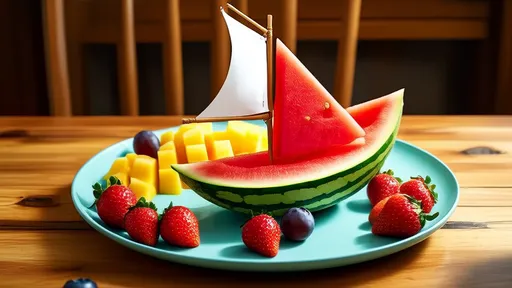
In the ever-evolving world of culinary creativity, a delightful trend has emerged that combines simplicity, nutrition, and whimsical charm: the fruit sailboat platter. This ingenious concept transforms ordinary fruits into a playful fleet of edible vessels, capturing imaginations and appetites alike. At its heart lies the humble banana, sliced and adorned with toothpick sails, creating an experience that is as enjoyable to assemble as it is to consume. The appeal spans generations, making it a standout choice for gatherings, children’s parties, or even a cheerful weekday snack.
The origins of food art trace back centuries, but the fruit sailboat is a modern twist on the age-old desire to make eating fun. Unlike intricate carvings or elaborate displays, this idea thrives on accessibility. It requires no professional skills or exotic ingredients—just a bit of imagination and everyday items found in most kitchens. The banana, with its sturdy texture and curved shape, serves as the perfect hull. When paired with vibrant sails crafted from paper, edible prints, or even thin slices of other fruits, it becomes a miniature masterpiece. The toothpick acts as both mast and connector, ensuring stability while adding to the nautical theme.
What makes this creation so engaging is its interactive nature. Unlike static dishes, the fruit sailboat invites participation. Families can gather to slice, skewer, and design together, turning food preparation into a shared activity. For children, it’s an edible toy that encourages healthy eating without the usual resistance. The visual appeal is immediate: a flotilla of colorful sails bobbing on a sea of banana bases, often accompanied by other fruit "islands" like berry clusters or melon balls. This transforms the plate into a dynamic landscape, sparking joy before the first bite is even taken.
Beyond its playful exterior, the fruit sailboat is a nutritional powerhouse. Bananas provide potassium and energy-boosting carbohydrates, while the sails—if made from fruits like apple slices or strawberries—add vitamins and antioxidants. The versatility allows for customization based on dietary needs or preferences. For instance, gluten-free or vegan options are inherent, and the inclusion of diverse fruits ensures a broad spectrum of nutrients. It’s a stealthy way to promote wellness, disguising healthful choices as whimsical treats.
The social media era has catapulted such ideas into the spotlight. Platforms like Instagram and Pinterest are flooded with images of these edible boats, often hashtagged for inspiration. Users share their variations: some add cheese sails for a savory twist, others use cookie cutters to shape the sails into stars or hearts. This digital sharing has fostered a community of home chefs who innovate and iterate, keeping the concept fresh and endlessly adaptable. The trend underscores a larger movement towards food that is not only nourishing but also visually storytelling.
From a practical standpoint, assembling a fruit sailboat platter is remarkably straightforward. Begin by selecting firm, slightly underripe bananas to prevent excessive softening. Slice them into thick rounds or halve them lengthwise for larger boats. For the sails, choose materials that contrast in color and texture—sturdy options include cardstock for non-edible versions or dried fruit for edibility. Insert a toothpick through the sail material and then into the banana base, ensuring it is secure but not so deep as to split the fruit. Arrange the boats on a platter with complementary fruits like blueberries as "water" or pineapple chunks as "rocks" to enhance the scene.
The cultural resonance of this idea is noteworthy. It echoes a universal fascination with miniaturization and play, reminiscent of toy boats in bathtubs or model ships. In many cultures, food shaped like animals or objects is common in festive traditions, symbolizing prosperity or joy. The fruit sailboat taps into this subconscious delight, making it universally appealing regardless of background. It’s a reminder that food transcends mere sustenance—it can be a source of wonder, connection, and creativity.
Event planners and parents have embraced the fruit sailboat for its dual function as decoration and snack. At birthday parties, it becomes a centerpiece that doubles as a healthy alternative to candy. Corporate events use them as light, refreshing options that encourage networking in a relaxed setting. Even educators have adopted it for classroom activities, teaching nutrition and motor skills through hands-on assembly. The low cost and high impact make it a versatile solution for various occasions.
Looking forward, the potential for innovation is vast. Imagine sailboats with LED-lit sails for evening events, or biodegradable toothpicks to enhance sustainability. Seasonal adaptations could include pumpkin-shaped sails for autumn or peppermint stripes for winter holidays. The basic framework is so flexible that it invites continuous reinvention, ensuring its place in culinary trends for years to come. As people seek more engaging ways to eat healthily and sustainably, concepts like this bridge the gap between necessity and pleasure.
In conclusion, the fruit sailboat platter is more than just a snack—it’s a testament to creativity’s role in everyday life. By turning simple ingredients into an interactive experience, it celebrates joy, nutrition, and togetherness. Whether enjoyed at a festive gathering or a quiet family moment, these tiny vessels carry with them a big message: that with a little imagination, even the simplest things can become extraordinary.
By /Aug 20, 2025

By /Aug 20, 2025

By /Aug 20, 2025
By /Aug 20, 2025
By /Aug 20, 2025
By /Aug 20, 2025

By /Aug 20, 2025
By /Aug 20, 2025

By /Aug 20, 2025
By /Aug 20, 2025
By /Aug 20, 2025
By /Aug 20, 2025
By /Aug 20, 2025
By /Aug 20, 2025
By /Aug 20, 2025
By /Aug 20, 2025

By /Aug 20, 2025
By /Aug 20, 2025

By /Aug 20, 2025
By /Aug 20, 2025
